What Metals Are Not Magnetic? A Complete Guide to Non-Magnetic Materials
Understanding what metals are not magnetic is crucial for engineers, recyclers, and tech enthusiasts alike. While we often associate metals with magnets, the reality is that the vast majority of metals on the periodic table do not exhibit magnetic properties under normal conditions. These are known as non-ferrous metals, meaning they lack the iron content necessary to create a strong magnetic pull. By exploring the atomic structure of these materials, we can better understand why some metals are ignored by magnets while others are strongly attracted. This knowledge is essential for applications ranging from MRI safety to the construction of sensitive electronic devices that require zero interference.
The Science Behind Non-Magnetic Metals
To grasp what metals are not magnetic, one must look at the arrangement of electrons within the metal’s atoms. In magnetic metals like iron, electrons have an “unpaired” spin that creates a small magnetic field, allowing them to align with external magnets. However, in non-magnetic metals, the electrons are paired in a way that their magnetic moments cancel each other out completely. This lack of alignment means that even when a powerful magnet is brought close, the metal remains indifferent and shows no physical attraction. This fundamental difference in atomic behavior is why we categorize materials into ferromagnetic, paramagnetic, and diamagnetic groups depending on their reaction to magnetic fields.
Top 5 Common Metals That Are Not Magnetic
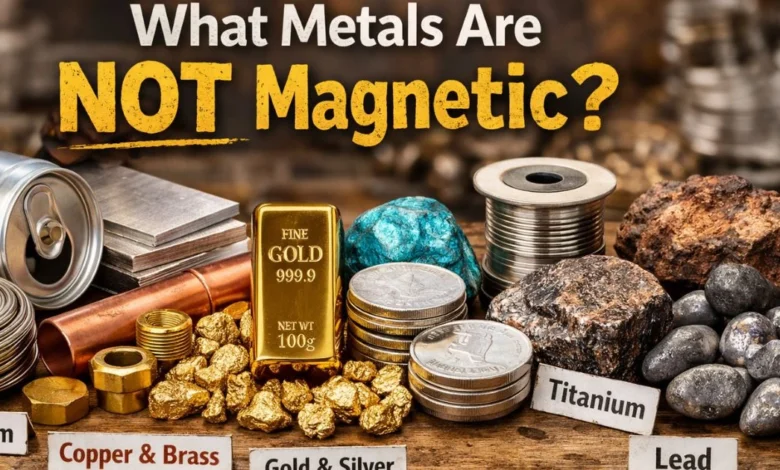
When discussing what metals are not magnetic, several everyday materials come to mind due to their widespread industrial and domestic use. Aluminum is perhaps the most famous example, used in everything from soda cans to aircraft frames because of its lightweight and non-magnetic nature. Copper follows closely, being the gold standard for electrical wiring where magnetic interference would be a significant technical disadvantage. Precious metals like gold, silver, and platinum also fall into this category, which is why a simple magnet test is often used to detect fake jewelry made of iron-based cores. Finally, lead and zinc are heavy hitters in the non-magnetic world, providing density and corrosion resistance without any magnetic pull.
Understanding the Role of Aluminum
Aluminum is a fascinating case study in the world of non-magnetic materials because it is technically paramagnetic, meaning it has an extremely weak attraction that is invisible to the human eye. In practical, everyday terms, however, aluminum is widely recognized as a metal that is not magnetic and will not stick to a fridge magnet. Its lack of magnetism makes it ideal for building enclosures for sensitive electronics, as it provides a shield without creating a magnetic field of its own.
The Importance of Copper in Electronics
Copper is an essential non-magnetic metal that powers our modern world through high-conductivity wiring and complex circuit boards. Because copper does not interact with magnetic fields, it allows electricity to flow smoothly without the risk of the metal being physically moved or vibrating near motors or transformers. This stability is a key reason why copper remains the preferred material for high-speed data cables and power grids globally.
Comparison of Magnetic vs. Non-Magnetic Metals
| Metal Category | Key Examples | Magnetic Status | Primary Tech Use |
| Ferromagnetic | Iron, Nickel, Cobalt | Strongly Magnetic | Motors, Transformers |
| Non-Ferrous | What metals are not magnetic? Aluminum, Copper | Non-Magnetic | Wiring, Aerospace |
| Precious Metals | Gold, Silver, Platinum | Non-Magnetic | Jewelry, Electronics |
| Alloys | 304 Stainless Steel, Brass | Non-Magnetic | Kitchenware, Valves |
Why “What Metals Are Not Magnetic” Matters in Industry
In the aerospace and medical industries, knowing what metals are not magnetic is a matter of safety and precision performance. For example, MRI machines use incredibly powerful magnets, so any tool or implant made of magnetic material would become a dangerous projectile. This is why titanium is used for medical implants; it is a strong, biocompatible metal that is not magnetic and won’t react during a scan. Similarly, in the shipping industry, non-magnetic brass is used for compass housings to ensure the needle points toward the Earth’s magnetic pole rather than the ship’s own structure.
Factors That Can Change Magnetic Properties
It is important to realize that the answer to what metals are not magnetic can sometimes change based on the metal’s temperature or its specific alloy composition. Some metals that are non-magnetic at room temperature can become magnetic if they are cooled to extremely low, cryogenic temperatures. Additionally, while pure iron is magnetic, mixing it with high levels of chromium and nickel can create “Austenitic” stainless steel, which is effectively non-magnetic. This demonstrates that magnetism is not just about the element itself, but also about how the atoms are arranged in a crystal structure.
(FAQs)
1. Is aluminum magnetic?
Aluminum is a non-ferrous and non-magnetic metal, which means it is not attracted to magnets. It is widely used in industries like packaging, construction, and transportation due to its lightweight and corrosion-resistant properties.
2. Is gold magnetic?
Pure gold is a non-magnetic metal and does not respond to magnetic fields. This is one of the reasons gold is easily distinguishable from many counterfeit metals when tested with a magnet.
3. Is stainless steel magnetic?
Stainless steel can be either magnetic or non-magnetic depending on its grade. For example, 304 and 316 stainless steel grades are generally non-magnetic, making them ideal for food processing, medical tools, and kitchen equipment.
4. Is copper magnetic?
Copper is a non-magnetic metal and does not stick to magnets. Due to its excellent electrical conductivity and non-magnetic nature, copper is widely used in electrical wiring and electronics.
5. Is brass magnetic?
Brass is a non-magnetic alloy made from copper and zinc, and it does not react to magnets. It is commonly used in decorative items, musical instruments, plumbing fittings, and hardware applications.
Conclusion
Understanding what metals are not magnetic is essential for selecting the right materials for construction, electronics, and medical safety. From the copper in our walls to the titanium in medical devices, these non-magnetic materials allow our technology to function without unwanted interference. By identifying these metals through their atomic structure and lack of iron, we can continue to innovate in fields where magnetic stability is a priority.