Free Preschool Assessment Checklist (Complete Guide for Teachers)
Track child development, learning progress, and preschool skills easily with this simple assessment checklist for teachers.
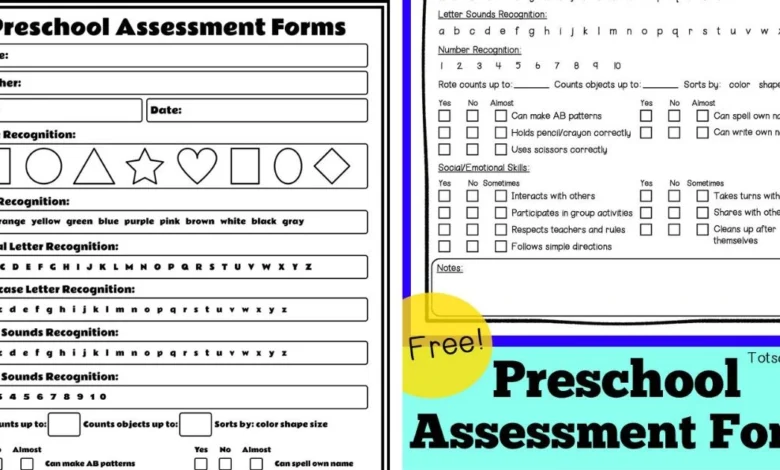
Early childhood education focuses on observing how children grow, learn, and interact with the world. A free preschool assessment checklist helps teachers and parents monitor developmental progress in an organized and practical way. Instead of relying on formal testing, preschool assessments are usually based on observation, play-based activities, and everyday classroom interactions.
This approach allows educators to evaluate children’s learning in a natural and stress-free environment. By using structured tools like a preschool assessment checklist, teachers can track skills, identify learning needs, and support every child’s development.
This guide explains preschool assessment methods, important skill areas, and how teachers can effectively use early childhood assessment tools in the classroom.You can also download a free printable preschool assessment checklist teachers can use in daily classroom observations.
What Is a Preschool Assessment Checklist?
A preschool assessment checklist is a structured tool used by teachers to observe and record a child’s developmental progress. It includes a list of skills that children typically learn during the preschool years, such as communication, motor skills, social interaction, and early academic abilities. Teachers review these skills and mark whether a child can perform them independently, with support, or not yet.
Unlike traditional exams, a developmental checklist for preschool focuses on real-life observations rather than written tests. Teachers may watch how children interact with classmates, participate in activities, or solve simple problems. These observations help create a clear picture of a child’s learning progress. As a result, educators can design lessons that match each child’s developmental stage.
Why Early Childhood Assessment Is Important
Understanding Child Development
Early childhood assessment helps teachers understand how children grow across multiple areas such as cognitive, physical, social, and emotional development. Every child develops at a different pace, so assessments provide valuable insight into individual progress. Observing these differences allows teachers to support each learner more effectively.
Supporting Individual Learning Needs
Children in preschool often have different learning styles and abilities. Using a preschool skills checklist helps educators recognize which skills a child has mastered and which areas need improvement. Teachers can then provide targeted activities to strengthen those skills.
Improving Lesson Planning
Assessment results guide teachers in creating meaningful learning experiences. When teachers understand students’ strengths and challenges, they can design lessons that are engaging and developmentally appropriate. This makes learning more effective and enjoyable for children.
Strengthening Parent Communication
A preschool progress report based on assessment observations allows teachers to communicate clearly with parents. Parents can see which skills their child is developing and how they can support learning at home.
A free preschool assessment checklist helps teachers organize observations and create accurate preschool progress reports for each child.
Key Components of a Preschool Assessment Checklist
A well-designed preschool assessment checklist covers multiple developmental areas. Each category focuses on specific skills that are essential for early childhood learning.
Cognitive Development
Cognitive skills involve thinking, reasoning, and problem-solving abilities. Preschool children begin to understand patterns, recognize shapes, and solve simple puzzles.
Examples include:
- Recognizing colors and shapes
- Completing simple puzzles
- Sorting objects by size or color
- Understanding cause and effect
Language and Communication Skills
Language development is a major focus of early childhood assessment. Teachers observe how children express themselves, listen to instructions, and interact in conversations.
Examples include:
- Speaking in short sentences
- Following simple instructions
- Asking and answering questions
- Recognizing basic vocabulary
Social and Emotional Skills
Preschool is an important time for children to develop social awareness and emotional regulation. A developmental checklist for preschool often includes behaviors related to cooperation, empathy, and classroom participation.
Examples include:
- Sharing toys with classmates
- Taking turns in group activities
- Expressing feelings appropriately
- Participating in group discussions
Fine Motor Skills
Fine motor skills involve small muscle movements used for writing, drawing, and manipulating objects. Teachers evaluate these abilities using a preschool skills checklist.
Examples include:
- Holding a pencil or crayon correctly
- Cutting with scissors
- Stacking blocks
- Drawing simple shapes
Gross Motor Skills
Gross motor development focuses on large body movements such as running, jumping, and balancing. Observing these skills helps teachers understand physical development.
Examples include:
- Running and jumping
- Climbing playground equipment
- Throwing and catching a ball
- Balancing while walking
Key Skills Included in a Free Preschool Assessment Checklist
A comprehensive free preschool assessment checklist usually includes important developmental areas such as language development, fine motor skills, social interaction, and early math concepts. Teachers rely on a free preschool assessment checklist to observe how children perform daily classroom tasks and learning activities.
Preschool Assessment Checklist Table
The following table shows an example of a preschool assessment checklist used in many classrooms.
| Development Area | Skill to Observe | Example Behavior |
| Language Skills | Recognizes letters | Identifies several alphabet letters |
| Cognitive Skills | Problem solving | Completes simple puzzles |
| Social Skills | Cooperation | Plays and shares with classmates |
| Fine Motor Skills | Pencil grip | Holds crayons correctly |
| Gross Motor Skills | Physical movement | Runs, jumps, and balances |
This table format helps teachers quickly track observations and organize information for preschool progress reports.
Free Preschool Assessment Checklist for Teachers
A free preschool assessment checklist usually includes several learning categories that represent different aspects of child development.
Classroom Readiness Skills

These skills indicate whether children are prepared to participate in classroom activities and routines.
Examples include:
- Follows simple instructions
- Participates in group activities
- Listens to teachers during story time
- Cleans up after activities
Literacy Readiness Skills
Early literacy skills form the foundation for reading and writing development.
Examples include:
- Recognizes alphabet letters
- Identifies rhyming words
- Understands story sequences
- Shows interest in books
Early Math Skills
Preschool math focuses on simple concepts such as counting, shapes, and patterns.
Examples include:
- Counts objects up to ten
- Recognizes basic shapes
- Identifies patterns
- Understands simple comparisons
Behavioral and Social Skills
A preschool skills checklist also evaluates how children interact with others in a classroom setting.
Examples include:
- Waits for a turn
- Shows respect to classmates
- Follows classroom rules
- Expresses emotions appropriately
Physical Development Skills
Physical skills support overall health and coordination.
Examples include:
- Runs and jumps confidently
- Climbs playground equipment
- Balances while walking
- Participates in physical activities
Preschool Skills Checklist Table
| Skill Category | Example Skills | Assessment Method |
| Literacy | Letter recognition, storytelling | Observation during reading time |
| Math | Counting, shape recognition | Hands-on counting activities |
| Social Skills | Sharing, cooperation | Group play observation |
| Motor Skills | Drawing, cutting | Art and craft activities |
| Physical Skills | Running, jumping | Outdoor play observation |
This type of table helps teachers organize preschool assessment tools efficiently.
Preschool Assessment Tools Teachers Commonly Use
Teachers use different preschool assessment tools to evaluate student development. These tools help gather meaningful information without creating pressure for young learners.
Observation Notes
Observation is one of the most reliable forms of early childhood assessment. Teachers watch how children behave, communicate, and interact during daily activities.
Portfolios
A portfolio is a collection of a child’s work, such as drawings, crafts, and writing samples. Reviewing these materials helps teachers evaluate progress over time.
Checklists
A developmental checklist for preschool provides a structured way to track developmental milestones. Teachers mark whether a skill has been achieved or still needs improvement.
Progress Reports
A preschool progress report summarizes assessment findings and shares them with parents. These reports highlight achievements and areas that may need additional support.
How Teachers Use Preschool Assessment in the Classroom?
In daily classroom routines, a free preschool assessment checklist helps educators evaluate learning outcomes, improve lesson planning, and ensure that every child receives proper developmental support.
Daily Observation
Teachers observe children during play, group discussions, and classroom activities. These observations help identify learning strengths and challenges.
Weekly Progress Monitoring
Using a preschool assessment checklist, teachers record observations weekly. This allows them to monitor growth over time and adjust teaching strategies when necessary.
End-of-Term Evaluation
At the end of a learning period, teachers review collected observations to create a preschool progress report. This report provides a clear overview of a child’s development.
Tips for Effective Preschool Assessment
Focus on Natural Learning
Assess children during normal classroom activities rather than creating formal testing situations. This approach reflects authentic learning behavior.
Keep Records Consistent
Consistent documentation ensures that assessment results remain accurate and reliable. Teachers should update their preschool skills checklist regularly.
Use Multiple Assessment Methods
Combining observation, checklists, and portfolios provides a complete picture of a child’s development.
Encourage Positive Learning
Assessments should highlight strengths while gently guiding areas that need improvement. This encourages confidence and motivation in young learners.
Common Mistakes in Preschool Assessment
| Mistake | Why It Is Problematic | Better Approach |
| Comparing children | Each child develops differently | Focus on individual progress |
| Over-testing | Creates unnecessary pressure | Use observation-based assessment |
| Ignoring social skills | Academic skills alone are not enough | Evaluate emotional and social development |
| Inconsistent records | Difficult to track progress | Maintain regular checklist updates |
Avoiding these mistakes ensures that early childhood assessment remains supportive and effective.
Benefits of Using a Preschool Assessment Checklist
Using a free preschool assessment checklist offers several advantages for teachers, students, and parents.
First, it provides a structured way to monitor learning progress. Teachers can easily track which skills children have mastered and which areas require additional support. Second, assessment checklists simplify lesson planning because educators can design activities that match students’ developmental levels. Third, these tools improve communication with parents through detailed preschool progress reports. Finally, using organized preschool assessment tools helps teachers create a balanced and supportive learning environment.
- Many educators prefer using a free preschool assessment checklist because it simplifies student evaluation and provides clear documentation for early childhood assessment.
Frequently Asked Questions
What is a preschool assessment checklist?
A preschool assessment checklist is a tool teachers use to track children’s developmental skills through observation and classroom activities.
What skills are included in a preschool skills checklist?
A preschool skills checklist usually includes cognitive, language, social, emotional, fine motor, and gross motor development.
How often should preschool assessments be done?
Teachers typically conduct early childhood assessments continuously through daily observation and record progress weekly or monthly.
Why are preschool assessment tools important?
Preschool assessment tools help teachers understand child development, plan effective lessons, and create meaningful progress reports for parents.
What is a preschool progress report?
A preschool progress report summarizes a child’s development, highlighting achievements and areas where additional support may be needed.
Conclusion
A free preschool assessment checklist is one of the most effective tools teachers can use to track development, improve teaching strategies, and support early childhood learning.
A free preschool assessment checklist is an essential resource for early childhood educators. It allows teachers to monitor student development across multiple skill areas without relying on stressful testing methods. By using structured preschool assessment tools, educators can observe learning behaviors, track developmental milestones, and create meaningful preschool progress reports.
These assessments also support better lesson planning and improve communication with parents. When used consistently, a developmental checklist for preschool helps ensure that every child receives the support they need to grow academically, socially, and emotionally.
Educators worldwide prefer using a free preschool assessment checklist because it simplifies early childhood assessment and supports better learning outcomes.