Homeschool STEM Curriculum: A Complete Beginner-Friendly Guide for Parents, Teachers, and Students
Hands-On Homeschool STEM Curriculum: Fun, Easy & Effective Learning at Home

A homeschool STEM curriculum is a structured learning plan that teaches Science, Technology, Engineering, and Mathematics at home in a hands-on, practical, and engaging way. It helps children build real-world problem-solving skills while learning core academic subjects in a fun and meaningful format.
If you’ve ever wondered how to teach science experiments, coding, math concepts, and engineering projects at home — without feeling overwhelmed — this guide is for you.
Why So Many Families Are Turning to Homeschool STEM Learning?
Many parents struggle with questions like:
- “How do I teach science without a lab?”
- “Is my child falling behind in math?”
- “How can I make learning exciting instead of boring worksheets?”
Traditional education often focuses on memorization. But STEM-based homeschooling focuses on doing, exploring, building, and thinking.
Instead of just reading about gravity — kids build marble roller coasters.
Instead of memorizing formulas — they solve real problems.
That’s the power of a homeschool STEM curriculum.
What Is a Homeschool STEM Curriculum?
A homeschool STEM curriculum combines:
- Science – experiments, observation, discovery
- Technology – coding, digital tools, robotics
- Engineering – building, designing, testing solutions
- Mathematics – logical thinking, problem solving, real-world math
Together, these subjects teach children how the world works.
Related Keywords (Naturally Used & Bolded):
- STEM homeschool programs
- home-based STEM education
- science curriculum for homeschoolers
- math and engineering learning at home
- hands-on STEM learning
- STEM lesson plans for homeschool
- online homeschool STEM courses
Why STEM Is Perfect for Homeschooling?
Homeschooling gives flexibility — and STEM thrives on flexibility.
Benefits:
1. Learn at your child’s pace
2. More experiments, less testing pressure
3. Real-world problem solving
4. Builds creativity + logic
5. Prepares kids for future careers
Core Parts of an Effective Homeschool STEM Curriculum
Let’s break it down simply.
1. Science at Home (Simple but Powerful)
Science teaches curiosity.
Easy Home Science Ideas:
- Growing plants and tracking growth
- Kitchen chemistry experiments
- Weather observation
- Simple physics projects
Example:
Sarah (Age 9) learned about evaporation by measuring water in cups placed in sun and shade daily.
Real learning. Real results.
2. Technology Learning (No Expert Needed!)
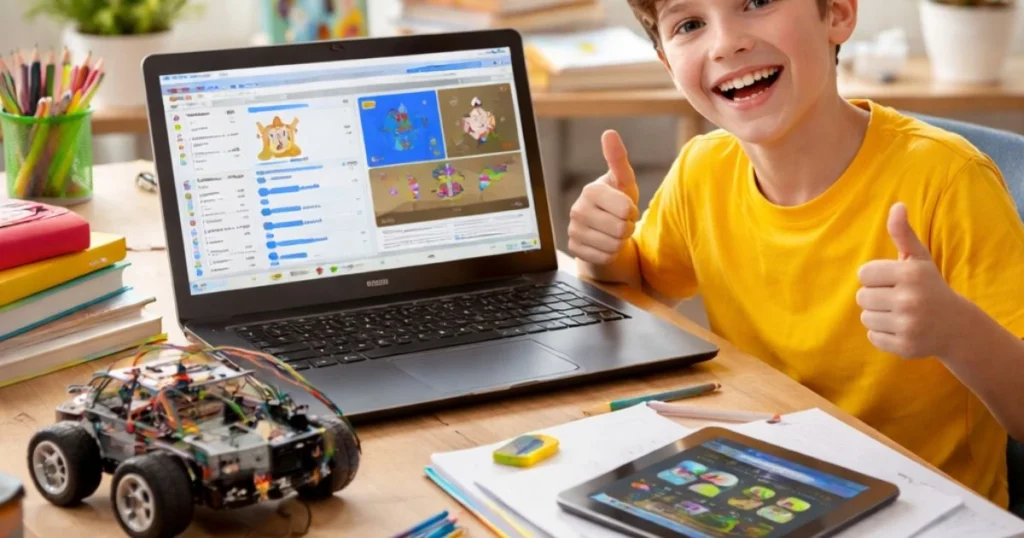
Technology isn’t just screen time.
It includes:
- Basic coding (Scratch, Python for kids)
- Digital research skills
- Robotics kits
- Educational apps
Example:
Jake (Age 11) created his first video game using Scratch while learning math logic.
3. Engineering Projects (Build to Learn)
Engineering teaches:
- Problem solving
- Design thinking
- Creativity
Fun Engineering Challenges:
- Build bridges with popsicle sticks
- Create marble runs
- Design water filters
- Construct paper towers
4. Math in Real Life
Forget boring worksheets.
Try:
- Cooking measurements
- Budgeting projects
- Geometry through building
- Graphing weather data
Example:
Emma (Age 13) planned a mini garden using area and perimeter calculations.
Age-Wise Homeschool STEM Curriculum Plan
| Age Group | Focus Areas | Example Activities | |
| 4–6 | Basic science + counting | Nature walks, simple experiments | |
| 7–9 | Intro engineering + math | Build bridges, basic coding | |
| 10–12 | Deeper science + tech | Robotics, real experiments | |
| 13–16 | Advanced STEM | Coding projects, physics labs |
How to Start a Homeschool STEM Curriculum (Step-by-Step)?
| Step | What to Do | Why It Matters |
| 1 | Assess child’s level | Avoid frustration |
| 2 | Choose resources | Keep learning structured |
| 3 | Mix hands-on + reading | Better understanding |
| 4 | Set weekly STEM days | Build routine |
| 5 | Track progress | See growth |
Popular Resources for Home-Based STEM Education
- Science experiment kits
- Coding platforms for kids
- Math manipulatives
- Engineering toy sets
- Online STEM lesson libraries
You don’t need expensive tools — creativity matters more.
Real-Life Homeschool STEM Success Stories
✔ Parent Perspective – Lisa (Mother of 3)
“My kids used to hate math. Once we started building projects and cooking measurements, they finally understood it.”
✔ Teacher Perspective – Mr. Roberts (Former Classroom Teacher)
“STEM homeschooling allows deeper learning than crowded classrooms ever could.”
✔ Student Perspective – Noah (Age 12)
“I built my own robot. Learning feels like playing now.”
Common Homeschool STEM Mistakes (And How to Fix Them)
| Mistake | Why It’s a Problem | Solution |
| Too many worksheets | Kills curiosity | Add hands-on projects |
| No routine | Inconsistent learning | Set weekly STEM time |
| Skipping experiments | Limits understanding | Do simple home labs |
| Overcomplicating | Frustrates kids | Keep it age-appropriate |
STEM Curriculum Comparison: Traditional vs Homeschool
| Feature | Traditional School | Homeschool STEM |
| Pace | Fixed | Personalized |
| Learning style | Lecture-based | Hands-on |
| Creativity | Limited | High |
| Real-world use | Low | High |
How STEM Prepares Kids for the Future?
STEM skills lead to careers in:
- Engineering
- Medicine
- Technology
- Data science
- Environmental science
Even non-STEM careers benefit from problem-solving skills.
Tips for Making STEM Fun at Home
- Let kids lead projects
- Celebrate mistakes as learning
- Use everyday materials
- Connect lessons to real life
- Encourage curiosity
FAQ – Homeschool STEM Curriculum
1. Do I need a science background to teach STEM at home?
No! Many programs are designed for parents with no technical experience.
2. How much time should STEM take weekly?
2–4 hours per week is great for younger kids. Older students may need more.
3. Is STEM enough for full homeschooling?
STEM should be combined with reading, writing, history, and arts.
4. Are online homeschool STEM courses effective?
Yes, when paired with hands-on activities.
5. Can STEM replace traditional textbooks?
It can supplement or replace many traditional methods — especially in science and math.
Key Takeaways
- A homeschool STEM curriculum teaches real-world skills through hands-on learning
- It builds curiosity, creativity, and confidence
- You don’t need to be an expert — just consistent
Tips for Students (Quick Boost!)
✔ Ask “why” often
✔ Try building things
✔ Don’t fear mistakes
✔ Keep a STEM notebook
Final Thoughts
A homeschool STEM curriculum isn’t about turning kids into scientists overnight.
It’s about:
✔ Teaching them how to think
✔ Helping them solve problems
✔ Making learning exciting
✔ Preparing them for real life
When children explore, build, test, and discover — education becomes powerful.
Whether you’re a parent just starting, a teacher guiding families, or a student curious about the world — STEM homeschooling offers one of the richest learning experiences available today