What is Range in Math: Definition, Formula, and Examples
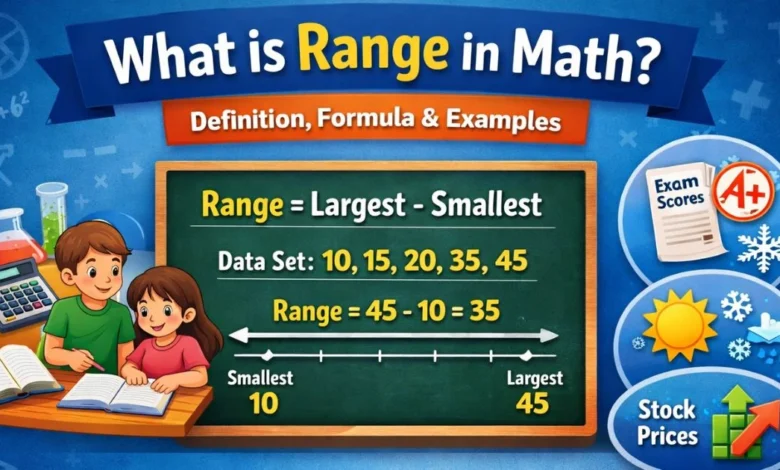
Understanding what is range in math is essential for analyzing data and numbers effectively. The range helps you see how spread out a set of numbers is by comparing the largest and smallest values. Whether you are working on exam scores, test results, or simple data sets, knowing the range makes it easier to summarize information quickly. Unlike other measures like mean or median, the range gives a simple, clear picture of the variation in numbers.
In this guide, we will explore what is range in math, its formula, examples, and practical applications, making it easy for students of all levels to grasp.
Definition of Range
The range is the difference between the largest and smallest numbers in a set. Simply put, understanding what is range in math means knowing how to measure the spread of values in any data set. For instance, if your class test scores are 40, 55, 60, 70, and 90, the range helps you see the gap between the highest and lowest scores. Range is a basic but powerful tool, especially when dealing with small data sets or comparing different sets of numbers. It is always a non-negative value because the largest number is always greater than or equal to the smallest number.
Formula to Calculate Range
Calculating range is straightforward. The formula is:
Range = Largest Number – Smallest Number
This simple formula works for integers, decimals, and even negative numbers. Using it correctly allows students to quickly find the spread of any given data set and fully understand what is range in math.
Example Table: How to Calculate Range
| Data Set | Largest Number | Smallest Number | Range Calculation | Range |
| {3, 7, 10, 15} | 15 | 3 | 15 – 3 | 12 |
| {-5, -2, 0, 4} | 4 | -5 | 4 – (-5) | 9 |
| {1.2, 3.5, 2.8} | 3.5 | 1.2 | 3.5 – 1.2 | 2.3 |
This table shows that range can be calculated in all types of number sets, including negative and decimal values. Knowing what is range in math helps students summarize data sets quickly and accurately.
Key Properties of Range
Range has several important properties that make it useful:
- It only depends on the largest and smallest values in the data set.
- It is always non-negative.
- It provides a quick measure of dispersion, though it doesn’t show details about all numbers.
- The range can highlight unusual values, such as extremely high or low numbers.
- It is ideal for small or simple data sets but less informative for larger or more complex data.
By understanding what is range in math, students can better interpret data and recognize patterns in a set of numbers.
Difference Between Range and Other Measures
While range shows the spread of numbers, it is different from other measures:
- Mean (Average): Adds all numbers and divides by the total count. Shows central tendency.
- Median: Middle value of a data set. Less affected by extreme values.
- Mode: Most frequently occurring number. Shows repetition patterns.
Unlike these measures, range only looks at the highest and lowest numbers, making it simpler but less detailed. Knowing what is range in math helps students avoid confusing it with these other calculations.
Real-Life Applications of Range
Range is used in many practical situations:
- Exam Scores: Teachers use range to see the gap between top and bottom students.
- Weather: Shows temperature variations between the hottest and coldest days.
- Sports: Compares the best and worst performances in a match.
- Finance: Analyzes the spread of stock prices over a period.
- Science Experiments: Measures variation in test results or data sets.
Using range in these scenarios allows for quick and easy insights. This is why understanding what is range in math is important beyond the classroom.
Common Mistakes While Calculating Range
Many students make simple mistakes when calculating range. The most common errors include:
- Subtracting the smaller number from a wrong value.
- Ignoring negative numbers or decimals.
- Confusing range with average or median.
Always remember the formula Range = Largest – Smallest, and check your numbers carefully to avoid mistakes. This ensures a clear understanding of what is range in math.
(FAQs)
1. Can range be negative?
No, range is always a non-negative number because it is the difference between the largest and smallest values.
2. Is range the same as average?
No, range shows the spread of numbers, while average shows the central value of a data set.
3. Can range include decimals?
Yes, range works for decimals as well as whole numbers and negative values.
4. Does range show all numbers in the set?
No, range only depends on the largest and smallest numbers in the set.
5. How to find range in a large data set?
Identify the maximum and minimum values in the data set and subtract the smallest from the largest.
Conclusion
Understanding what is range in math is a fundamental skill that simplifies the study of numbers and data. It provides a clear view of how values are spread, highlights differences between extremes, and is applicable in real-life scenarios such as exam scores, weather, sports, and finances.
While simple to calculate, the range is powerful for summarizing data quickly, especially for students and beginners. By mastering the concept of range, you can easily analyze any data set, compare numbers, and gain meaningful insights at a glance.