Creative Curriculum for Infants and Toddlers: A Practical Guide
A Complete Beginner’s Guide to Building Strong Early Foundations Through Play and Care
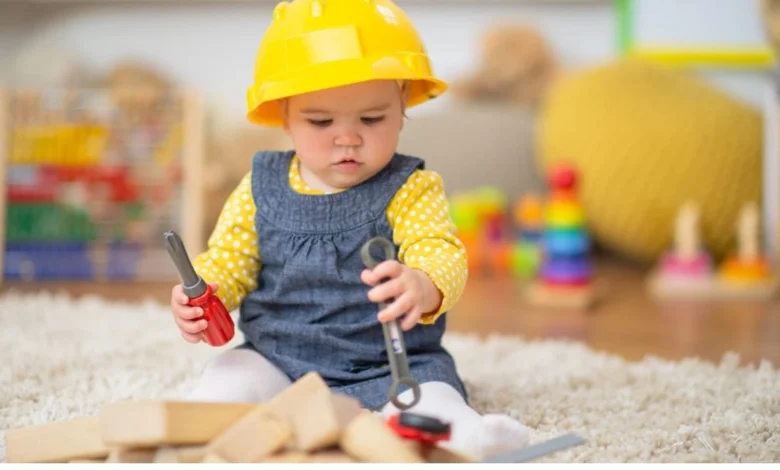
The creative curriculum for infants and toddlers is a relationship-based, play-centered early childhood approach designed for children from birth to age three.
It supports healthy brain development by turning everyday routines, exploration, and caregiver interactions into meaningful learning experiences.
Introduction: “I Just Want to Do This Right.”
Let me start with something honest.
Almost every new parent, childcare provider, or early childhood teacher has had this quiet worry:
“Am I doing enough?”
You see toddlers on social media identifying colors and counting to ten. You hear about babies using flashcards. You walk into a toy store and feel overwhelmed by “educational” products.
At the same time, you look at a one-year-old happily stacking cups or banging spoons and wonder:
Is this really learning?
Yes. It absolutely is.
The creative curriculum for infants and toddlers helps us understand that early learning is not about pushing academics. It is about building the foundation that makes academics possible later.
And that foundation is built through:
- Safe relationships
- Purposeful play
- Exploration
- Conversation
- Consistent routines
In this in-depth guide, I’ll walk you through everything you need to know in simple, practical language. No confusing theory. No unrealistic expectations. Just clear guidance rooted in real classrooms and real homes.
What Is the Creative Curriculum for Infants and Toddlers?
The creative curriculum for infants and toddlers is an early childhood education framework designed specifically for children from birth to three years old. It recognizes that infants and toddlers learn differently from older preschoolers or school-age children.
The creative curriculum for infants and toddlers is a research-based early learning approach that supports whole-child development through play, relationships, and daily routines. Many educators choose the creative curriculum for infants and toddlers because it respects how babies and young children naturally learn through exploration and interaction. At its core, the creative curriculum for infants and toddlers focuses on social-emotional growth, language development, cognitive skills, and physical coordination in a balanced way. In classrooms, the creative curriculum for infants and toddlers encourages teachers to observe children carefully and plan meaningful activities based on their interests.
Parents can also apply the creative curriculum for infants and toddlers at home by turning everyday routines like feeding, storytelling, and outdoor walks into learning moments. One major benefit of the creative curriculum for infants and toddlers is that it builds strong brain connections during the most important years of development. Through observation, the creative curriculum for infants and toddlers allows caregivers to support each child’s unique pace and personality. When implemented consistently, the creative curriculum for infants and toddlers strengthens confidence, curiosity, and independence. Overall, the creative curriculum for infants and toddlers builds a powerful foundation for lifelong learning and school readiness.
Instead of structured lessons and worksheets, it focuses on:
- Responsive caregiving
- Developmentally appropriate practice
- Play-based learning
- Observation-based planning
- Whole-child development
This approach is widely used in infant classrooms, toddler programs, family childcare homes, and early learning centers.
But it is just as powerful at home.
Why the First Three Years Matter More Than We Think?
If you only remember one thing from this article, remember this:
The first three years shape how children learn, feel, and connect for the rest of their lives.
During this time:
- Brain connections form rapidly.
- Emotional attachment patterns develop.
- Language pathways begin building.
- Self-regulation skills start forming.
Infants are not “too young” to learn.
They are learning constantly.
The question is not whether they are learning.
The question is what kind of environment is shaping that learning.
That’s where a strong infant and toddler curriculum makes the difference.
This topic is part of the complete guide on the importance of curriculum in education.
Core Principles of the Creative Curriculum
Let’s break this down clearly and simply.
1. Relationships Come First
Before a child can explore confidently, they must feel safe.
When a caregiver consistently responds to crying, smiles warmly, and speaks gently, the child develops trust. That trust allows exploration.
Without emotional security, learning slows down.
2. Play Is Not a Break From Learning — It IS Learning
When a toddler:
- Drops food repeatedly
- Stacks blocks
- Pushes a toy car back and forth
- Pretends to cook
They are developing:
- Motor skills
- Cause-and-effect understanding
- Language
- Social skills
- Problem-solving
Play is brain-building work.
3. The Environment Matters
The setup of a room influences behavior and development.
A thoughtful environment includes:
- Soft, safe flooring
- Low shelves
- Simple, organized materials
- Cozy reading areas
- Open floor space for movement
Too many toys can overwhelm. Fewer, meaningful materials encourage deeper play.
4. Observation Guides Teaching
In the creative curriculum for infants and toddlers, teachers don’t guess.
They observe.
For example:
A toddler repeatedly puts objects into containers and dumps them out.
Instead of stopping the behavior, the teacher recognizes a pattern: the child is exploring volume and containment.
The next day, she adds different-sized containers.
That is intentional teaching.
Developmental Domains Supported
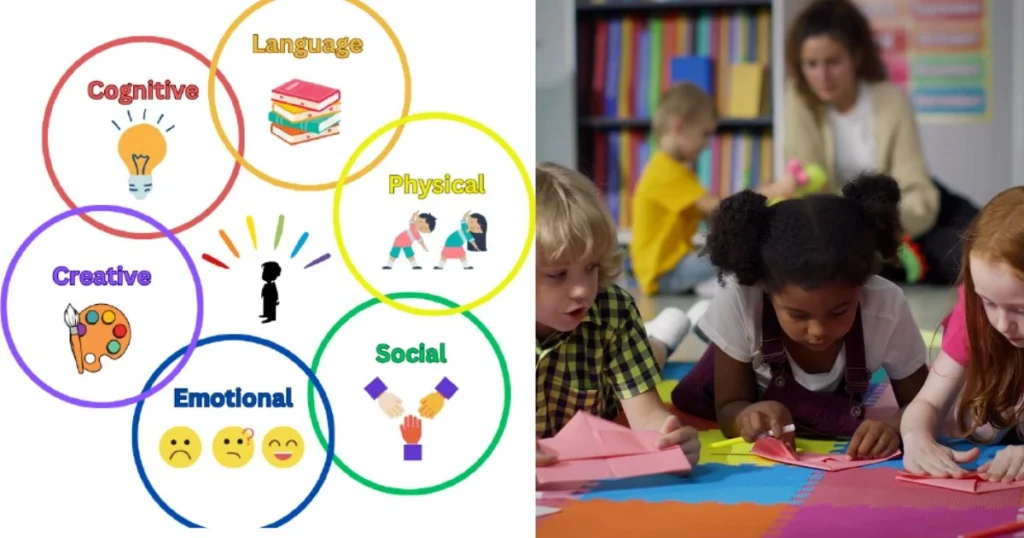
The curriculum supports five major areas of development.
Social-Emotional Development
Children learn:
- Trust
- Emotional regulation
- Confidence
- Cooperation
Example: A caregiver calmly helps a toddler wait for a turn instead of immediately solving the problem.
Physical Development
Infants and toddlers build:
- Gross motor skills (crawling, walking, climbing)
- Fine motor skills (grasping, stacking, turning pages)
Movement strengthens both muscles and neural pathways.
Language Development
Language development starts long before speech.
Babies learn through:
- Hearing conversations
- Listening to songs
- Watching facial expressions
- Responding to tone
The more adults talk with children, the stronger language skills become.
Cognitive Development
Through play, children develop:
- Memory
- Cause-and-effect understanding
- Problem-solving
- Curiosity
Even peekaboo supports object permanence — a major cognitive milestone.
Approaches to Learning
This includes:
- Curiosity
- Persistence
- Focus
- Creativity
These traits are more important in the long run than early memorization.
Age-Wise Learning Focus
Table 1: Developmental Focus by Age
| Age | Main Focus | Example Activities | Adult Support |
| 0–6 months | Attachment & sensory exploration | Tummy time, face-to-face talk | Comfort & respond quickly |
| 6–12 months | Movement & curiosity | Crawling tunnels, peekaboo | Encourage exploration |
| 12–24 months | Language & independence | Naming objects, stacking | Expand vocabulary |
| 24–36 months | Social skills & problem-solving | Pretend play, puzzles | Guide cooperation |
How It Looks in Real Classrooms
Let’s make this practical.
Example 1: Infant Classroom
A 5-month-old cries during tummy time.
Instead of ending the activity immediately, the teacher lies next to the baby, makes eye contact, and talks softly.
The baby stays longer.
Learning happening:
- Neck muscle development
- Emotional security
- Language exposure
No formal lesson. Still powerful learning.
Example 2: Toddler Conflict
Two toddlers want the same truck.
Instead of removing it, the teacher says:
“You both want the truck. Let’s take turns.”
She uses a short timer.
Skills developing:
- Patience
- Emotional regulation
- Communication
- Social awareness
Example 3: Home Setting
A parent includes their toddler while folding laundry.
“Can you find the small socks?”
The toddler sorts by size.
Skills developing:
- Early math concepts
- Vocabulary
- Fine motor skills
- Independence
Learning doesn’t require a special classroom.
Learning Through Daily Routines
Routines are not interruptions to learning. They ARE learning.
Table 2: Turning Routines into Learning Moments
| Routine | Learning Focus | Example |
| Feeding | Vocabulary & bonding | “This banana is soft.” |
| Diaper change | Body awareness | “I’m putting on your shoes.” |
| Outdoor walk | Observation | “The sky is blue.” |
| Clean-up | Responsibility | “Let’s put blocks away.” |
Creative Curriculum vs Early Academic Pressure
Table 3: Comparison
| Creative Curriculum | Academic Pressure Approach |
| Play-based | Worksheet-based |
| Child-led | Adult-directed |
| Emotional safety first | Performance first |
| Flexible development | Fixed expectations |
Common Mistakes and How to Avoid Them
Table 4: Mistakes vs Solutions
| Mistake | Why It Hurts Development | Better Choice |
| Pushing reading too early | Creates stress | Focus on language-rich talk |
| Too many toys | Overstimulation | Rotate materials |
| Ignoring emotions | Weak attachment | Respond consistently |
| Heavy screen time | Delays language growth | Increase conversation |
Teacher Perspective
Many teachers say:
“When I stopped rushing and started observing, my classroom became calmer and children were more engaged.”
The curriculum works because it respects development.
Parent Perspective
Parents often notice:
- Improved communication
- Fewer behavior struggles
- Greater independence
- More curiosity
It’s not about doing more activities.
It’s about being intentional during daily life.
Frequently Asked Questions
1. Is the creative curriculum only for childcare centers?
No. Parents can apply it at home easily.
2. Does it prepare children for kindergarten?
Yes. It builds emotional regulation, attention, and communication — all critical for school readiness.
3. Is it expensive?
Not at all. Everyday household items work perfectly.
4. How is progress measured?
Through observation and developmental milestones, not formal testing.
5. Can children with delays benefit?
Yes. The flexible, individualized approach supports diverse needs.
Tips for Students (Early Childhood Education Majors)
- Watch children before planning.
- Respect developmental stages.
- Focus on relationships first.
- Use clear, simple language.
- Remember that play builds brains.
Conclusion:
The creative curriculum for infants and toddlers reminds us of something powerful:
Early childhood is not about rushing ahead.
It is about building secure foundations.
When caregivers focus on:
- Warm relationships
- Thoughtful environments
- Play-based exploration
- Language-rich interaction
Children develop:
- Confidence
- Curiosity
- Emotional strength
- Strong communication skills
3 Key Takeaways
- Relationships are the heart of early learning.
- Play is real, meaningful education.
- Everyday moments are powerful teaching opportunities.
When we slow down and trust development, we don’t fall behind.
We build children who are ready — not just for school — but for life.