Mechanical Engineering Curriculum Map: Beginner’s Guide for Students
Master Mechanical Engineering Step by Step with a Clear Curriculum Map
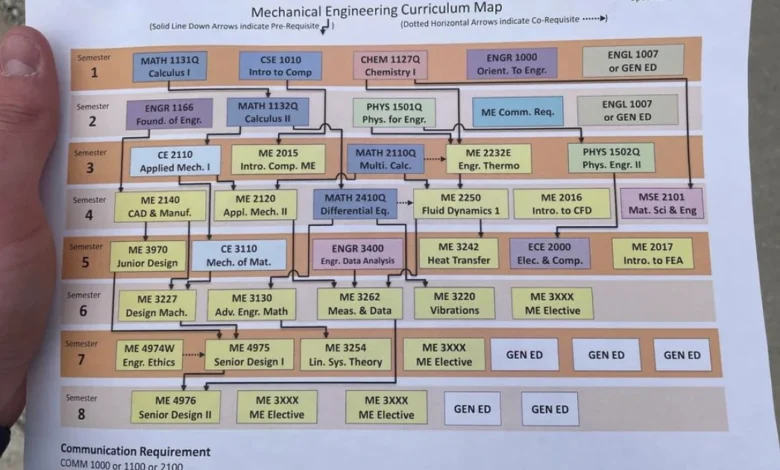
A mechanical engineering curriculum map is a clear learning roadmap that shows what students study each year, how subjects connect, and how skills develop over time. It helps students, teachers, and institutions organize learning in a structured and meaningful way from basics to advanced engineering applications.
If you’ve ever wondered “What will I actually learn in mechanical engineering year by year?” or struggled to plan courses logically — this guide is for you.
Introduction: Why Most Students Feel Lost in Engineering Programs?
Many students enter mechanical engineering excited… but soon feel overwhelmed.
“Why am I studying thermodynamics before I understand machines?”
“How does calculus connect to real engineering work?”
“Am I learning skills employers actually want?”
Teachers face it too — trying to balance theory, labs, and practical skills.
This is exactly why a mechanical engineering curriculum map matters.
It organizes:
- Subjects in logical progression
- Skills development step by step
- Real-world engineering applications
Instead of random courses, students follow a clear learning journey.
This topic is part of the complete guide on the importance of curriculum in education.
Let’s break it down simply.
What Is a Mechanical Engineering Curriculum Map?
A mechanical engineering curriculum map is a structured plan that:
✔ Shows courses by year/semester
✔ Connects skills to subjects
✔ Builds from fundamentals to advanced design
✔ Aligns education with industry needs
Think of it as a GPS for engineering education.
Without a map → learning feels scattered
With a map → learning feels purposeful
Core Goals of a Curriculum Map
| Goal | Why It Matters |
| Logical course flow | Prevents confusion |
| Skill progression | Builds real competence |
| Balanced theory & practice | Prepares for jobs |
| Learning outcomes | Tracks progress clearly |
Why Curriculum Mapping Matters in Mechanical Engineering?
Mechanical engineering is not memorization — it’s applied problem solving.
A good curriculum map helps:
1.Students understand the “why” behind subjects
2.Teachers design better lessons
3. Parents see learning value
4. Schools meet accreditation standards
Real-Life Example #1: College Student
Ali struggled with fluid mechanics because he didn’t fully grasp calculus and physics first.
After his university introduced a structured curriculum map:
- Math and physics came earlier
- Labs matched theory
- Understanding improved dramatically
Result: Higher grades + confidence.
Real-Life Example #2: High School STEM Program
A teacher used a mini mechanical engineering curriculum map for robotics students:
Year 1 → Basics of forces & motion
Year 2 → Machines and CAD
Year 3 → Design projects
Students built real working robots by senior year.
Real-Life Example #3: Homeschool Engineering Track
A homeschooling parent followed a curriculum map approach:
- Math + physics foundation
- Hands-on engineering kits
- Gradual technical skills
Result: Student entered university well-prepared.
Mechanical Engineering Curriculum Map – Year-by-Year Breakdown
Let’s walk through a typical 4-year undergraduate structure.
Year 1: Engineering Foundations
Main Focus: Build strong basics
| Subject Area | What Students Learn |
| Mathematics | Calculus, algebra, vectors |
| Physics | Mechanics, energy |
| Engineering drawing | Technical sketches |
| Programming basics | MATLAB/Python |
| Materials intro | Properties of metals |
Skills Developed:
✔ Problem solving
✔ Logical thinking
✔ Technical communication
Year 2: Core Mechanical Concepts
| Subject | Purpose |
| Thermodynamics | Energy systems |
| Statics & Dynamics | Forces & motion |
| Strength of materials | Stress & strain |
| Manufacturing processes | How parts are made |
| Fluid mechanics | Flow behavior |
Skills Developed:
✔ Analytical reasoning
✔ Engineering calculations
✔ Understanding real machines
Year 3: Applied Engineering
| Subject | Application |
| Heat transfer | Cooling systems |
| Machine design | Gear systems |
| Control systems | Automation |
| CAD/CAM | Digital design |
| Mechanical vibrations | Stability |
Skills Developed:
✔ Design thinking
✔ Software proficiency
✔ System analysis
Year 4: Advanced & Professional Skills
| Subject | Outcome |
| Capstone project | Real engineering solution |
| Advanced thermodynamics | Power systems |
| Robotics or mechatronics | Smart machines |
| Engineering management | Team leadership |
| Industry internship | Real-world experience |
Skills Developed:
✔ Project management
✔ Problem solving
✔ Professional readiness
Subjects Breakdown by Engineering Domains
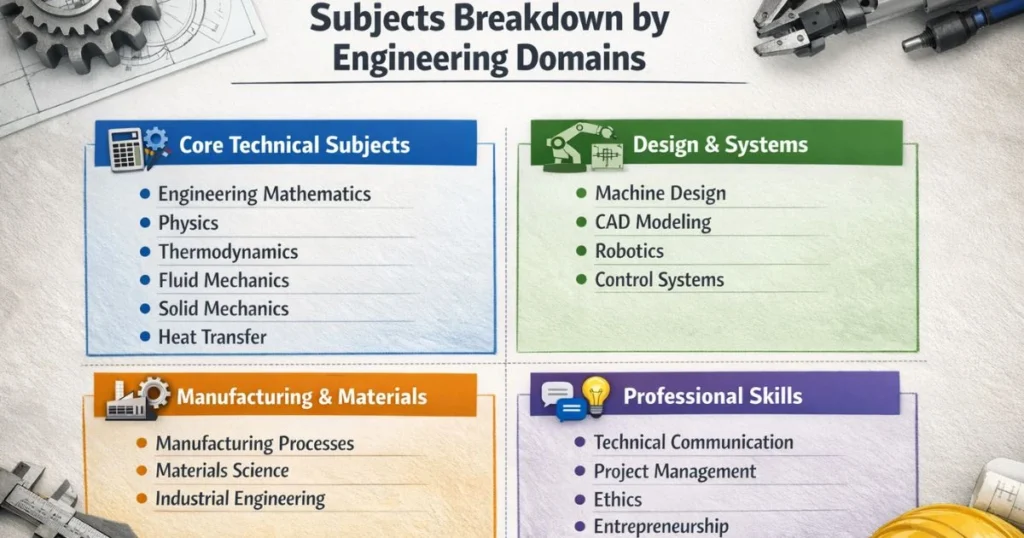
Core Technical Subjects
- Engineering mathematics
- Physics
- Thermodynamics
- Fluid mechanics
- Solid mechanics
- Heat transfer
Design & Systems
- Machine design
- CAD modeling
- Robotics
- Control systems
Manufacturing & Materials
- Manufacturing processes
- Materials science
- Industrial engineering
Professional Skills
- Technical communication
- Project management
- Ethics
- Entrepreneurship
Skills Alignment: What Students Gain Each Year
| Year | Technical Skills | Soft Skills |
| 1 | Math, drawing, coding | Study habits |
| 2 | Engineering analysis | Problem solving |
| 3 | Design software | Teamwork |
| 4 | Real projects | Leadership |
Benefits of Using a Mechanical Engineering Curriculum Map
For Students
- Clear expectations
- Less confusion
- Better career readiness
For Teachers
- Organized teaching plans
- Balanced workloads
- Better assessments
For Schools
- Accreditation support
- Curriculum quality
- Improved outcomes
Common Curriculum Mapping Mistakes (And Solutions)
| Mistake | Why It Hurts | Solution |
| Random subject order | Confusion | Logical progression |
| Too much theory | Boredom | Add labs/projects |
| No skills focus | Poor job readiness | Align with industry |
| Overloaded semesters | Burnout | Balance workload |
Teacher, Student & Parent Perspectives
Student View
“Seeing the curriculum map helped me understand why each subject mattered.”
Teacher View
“It made lesson planning smoother and outcomes clearer.”
Parent View
“I finally understood how engineering skills develop over time.”
Sample Mechanical Engineering Curriculum Map (Simplified)
| Year | Focus | Key Outcome |
| 1 | Foundations | Strong basics |
| 2 | Core engineering | System understanding |
| 3 | Design & application | Practical skills |
| 4 | Projects & industry | Job readiness |
Downloadable Sample Map (Concept)
You can create a printable version using:
- Excel or Google Sheets
- Semester-wise layout
- Skills column
How Schools Can Build Their Own Curriculum Map
Step-by-Step Process
| Step | Action |
| 1 | Define learning outcomes |
| 2 | List subjects |
| 3 | Arrange logically |
| 4 | Match skills |
| 5 | Review annually |
Related Keywords Used Naturally
- mechanical engineering course structure
- engineering curriculum planning
- mechanical engineering syllabus roadmap
- engineering education framework
- mechanical engineering degree plan
- curriculum mapping in engineering
- engineering learning pathway
FAQs: Mechanical Engineering Curriculum Map
1. Is a curriculum map the same as a syllabus?
No. A syllabus lists course topics. A curriculum map shows how all courses connect across years.
2. Can high schools use engineering curriculum maps?
Absolutely. Many STEM programs use simplified versions to prepare students early.
3. How often should a curriculum map be updated?
Ideally every 2–3 years to match industry needs.
4. Does curriculum mapping improve student success?
Yes. Studies show better understanding, retention, and career readiness.
Tips for Students (Quick Guide)
✔ Review your curriculum map each semester
✔ Connect subjects to real applications
✔ Balance theory with practice
✔ Ask teachers how courses link together
Conclusion: Why Every Engineering Program Needs a Curriculum Map?
A strong mechanical engineering curriculum map transforms education from scattered subjects into a powerful learning journey.or.A strong mechanical engineering curriculum map turns scattered subjects into an organized and meaningful learning journey.
It helps students:
- Learn with purpose
- Build skills gradually
- Prepare for real engineering careers
Teachers teach better.
Parents understand progress.
Schools produce better engineers.
Key Takeaways
- A curriculum map organizes mechanical engineering learning logically
- It aligns subjects with real-world skills
- It improves student success and clarity
- Gradually strengthens skill development
- Helps teachers with better planning
Flash Topic