What is Curriculum Development? A Complete Guide for Students
Step-by-Step Approach to Curriculum Development
Introduction
Hey students! If you’re studying education, planning to be a teacher, or just curious about how schools and colleges decide what to teach, you’re in the right place. In this guide, we’ll explore what is curriculum development , why it matters, how it works, and some easy tips to understand it.
By the end, you’ll be able to explain curriculum development in your own words, understand its steps, and even connect it with examples from real life.
This topic is part of the complete guide on the importance of curriculum in education.
Let’s dive in!
1. What is Curriculum Development?
Simply put, curriculum development is about planning what students should learn in school, college, or a course. It’s about designing lessons, activities, and assessments in a way that makes learning effective and meaningful.
Think of it like a roadmap for learning. Just like a map shows you the way from point A to point B, a curriculum shows teachers and students what to learn, in what order, and how.
Example:
In a science class, the curriculum might look like this:
- Learn about plants and animals first.
- Then basic physics, like force and motion.
- Later, chemistry experiments.
Without a curriculum, learning could feel random and confusing — like trying to reach a destination without a map!
2. Why Curriculum Development is Important
Curriculum development is super important because it helps students, teachers, and schools in many ways:
For Students:
- Clear learning path: You know what to study and when.
- Better understanding: Lessons are organized logically.
- Skill development: Focuses not just on knowledge, but also on skills.
For Teachers:
- Teaching guide: Helps plan lessons and activities.
- Consistency: Ensures all students learn the same core concepts.
- Resource planning: Teachers know what books or materials to use.
For Schools:
- Quality education: Maintains a standard of teaching.
- Better learning outcomes: Students perform better in exams.
- Adaptable: Schools can update the curriculum with new knowledge or skills.
In short: Curriculum development keeps learning organized, meaningful, and effective.
3. Key Principles of Curriculum Development
When educators create a curriculum, they follow some key principles to make sure learning is effective and meaningful. Here’s a simple way to understand them:
| Principle | What it Means | Example |
| Student-centered | Focus on what students need and can do | Activities based on age, interest, or level |
| Goal-oriented | Each lesson has a clear purpose | Learning fractions using real-life examples like pizza slices |
| Balanced | Combines knowledge, skills, and values | Science + arts + moral lessons |
| Flexible | Can adjust to new topics or student needs | Adding coding lessons for tech updates |
| Progressive | Builds knowledge step by step | Start with letters → words → sentences in English |
Tip: Always think about the students first. The curriculum should make learning easier and interesting for them, not just follow rules blindly.
4. Types of Curriculum
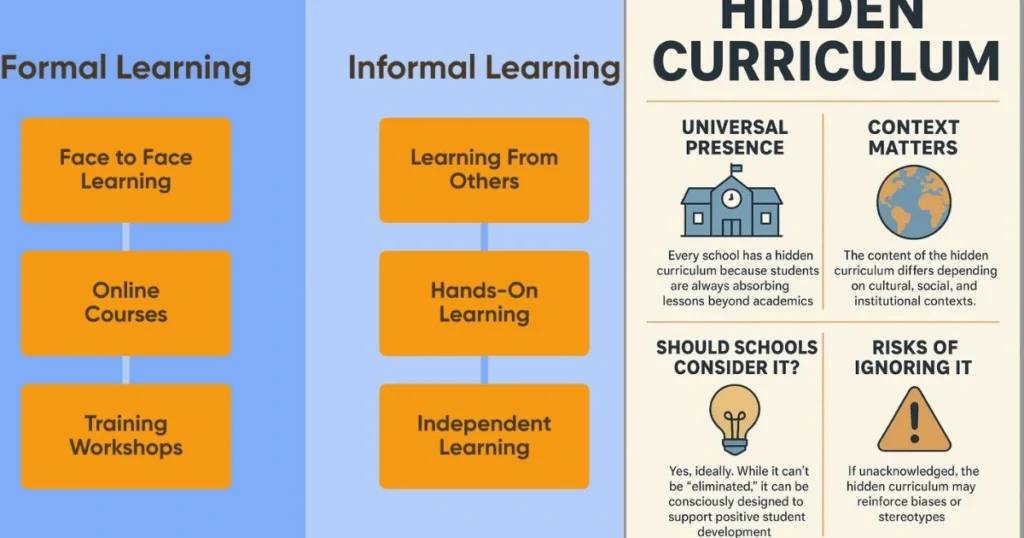
Curriculum isn’t just one thing — it comes in different types. Let’s break them down:
4.1 Formal Curriculum
- Planned and structured.
- Found in textbooks, lesson plans, and syllabi.
- Example: NCERT syllabus in India.
4.2 Informal Curriculum
- Unplanned learning that happens naturally at school.
- Example: Learning teamwork through group activities.
4.3 Hidden Curriculum
- Lessons learned without anyone explicitly teaching them.
- Example: Learning discipline by following school rules or being punctual.
Tip: Even hidden and informal curriculum matter a lot because students pick up skills and values beyond textbooks.
5. Steps in Curriculum Development
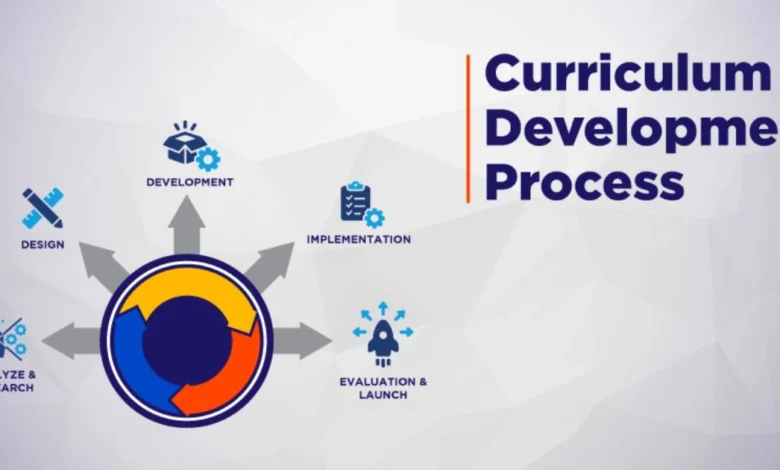
Developing a curriculum isn’t random — it follows a clear process. Here’s a step-by-step guide:
- Identify Goals and Objectives
- Ask: “What should students learn?”
- Example: Students should be able to solve basic algebra problems.
- Ask: “What should students learn?”
- Analyze Learners
- Understand students’ age, needs, and background.
- Example: Primary students need colorful, simple examples; high schoolers can handle theory.
- Understand students’ age, needs, and background.
- Select Content
- Pick the topics, concepts, and materials to teach.
- Example: Science curriculum → plants, animals, energy, environment.
- Pick the topics, concepts, and materials to teach.
- Organize Content
- Arrange topics logically, from simple to complex.
- Example: Teach addition before multiplication in math.
- Arrange topics logically, from simple to complex.
- Choose Learning Experiences
- Decide on activities, experiments, or projects.
- Example: Plant seeds in class to learn about plant growth.
- Decide on activities, experiments, or projects.
- Organize Learning Experiences
- Make a schedule (weekly or monthly) to keep learning structured.
- Example: Week 1 → Photosynthesis, Week 2 → Plant reproduction.
- Make a schedule (weekly or monthly) to keep learning structured.
- Evaluate and Revise
- Check if students are learning effectively and adjust if needed.
- Example: If fractions aren’t clear, give extra exercises or games.
- Check if students are learning effectively and adjust if needed.
Visual Table of Steps:
| Step | Action | Example |
| 1 | Identify goals | Learn basic algebra |
| 2 | Analyze learners | Class 6 students |
| 3 | Select content | Algebra topics |
| 4 | Organize content | Simple → Complex |
| 5 | Choose learning experiences | Worksheets, games |
| 6 | Organize experiences | Weekly plan |
| 7 | Evaluate & revise | Test → Extra practice |
6. Approaches to Curriculum Development
There isn’t just one way to design a curriculum — educators use different approaches depending on goals and students. Here are the main ones:
6.1 Subject-Centered Approach
- Focuses on subjects like Math, Science, History.
- Pros: Easy for teachers, clear content.
- Cons: May ignore student interests or skills.
- Example: Following a strict NCERT syllabus for all students.
6.2 Learner-Centered Approach
- Focuses on students’ needs, interests, and abilities.
- Pros: Motivates students, helps develop skills.
- Cons: Harder to plan for large classes.
- Example: Letting students choose science projects based on what excites them.
6.3 Problem-Centered Approach
- Focuses on solving real-life problems.
- Pros: Develops critical thinking and practical skills.
- Example: Teaching pollution control in environmental science class.
Tip: Most modern curricula combine these approaches to balance knowledge, skills, and real-life learning.
7. Factors Affecting Curriculum Development
Curriculum doesn’t exist in isolation — many factors affect how it’s designed.
| Factor | What it Means | Example |
| Society & Culture | Should reflect local traditions and values | Indian history, festivals, moral lessons |
| Technology | Include latest tools and digital learning | Online classes, coding, educational apps |
| Government Policy | Boards or education rules influence content | CBSE, ICSE, or state syllabus |
| Student Needs | Age, interest, and learning ability matter | Younger kids → practical lessons, older kids → theory |
| Resources | Availability of teachers, books, labs | Schools with labs can teach chemistry practically |
8. Examples of Curriculum Development in Schools
Let’s look at how it works in real life:
Example 1: Science Curriculum for Class 6
- Goal: Get a clear understanding of basic science concepts..
- Content: Learn about plants, animals, energy, and the environment.
- Learning experiences:Through experiments, worksheets, and group activities that let you explore and practice what you’ve learned.
- Evaluation:Your understanding will be checked through class tests and practical assignments that focus on real learning, not just memorizing.
Example 2: English Language Curriculum
- Goal: Improve reading and writing skills.
- Content: Vocabulary, grammar, comprehension.
- Learning experiences: Storytelling, essay writing, discussions.
- Evaluation: Quizzes, writing exercises, oral presentations.
Tip: When you look at real school examples, you can see how theory is connected to activities and assessments.
9. Tips for Students to Understand Curriculum Development
- Think like a teacher: Try planning a mini-syllabus for your favorite subject.
- Use real-life examples: Relate lessons to daily life.
- Check old syllabi: See how topics are organized and build on each other.
- Practice step-by-step learning: Follow small goals, don’t rush.
- Discuss with teachers: Ask why certain topics come first.
- Use charts and tables: Helps you visualize progress.
10. Common Mistakes in Curriculum Development
Even experts make mistakes. Avoid these:
- Ignoring student needs.
- Overloading topics in one term.
- Skipping evaluation or feedback.
- Copying other schools without adapting.
- Not updating with new knowledge or technology.
Tip: Always remember — curriculum is for students, not just for following rules.
11. FAQs About Curriculum Development
Q1: What is the main purpose of curriculum development?
A: To organize learning so students can understand, practice, and apply knowledge effectively.
Q2: Who develops the curriculum?
A: Teachers, school boards, education experts, and sometimes government authorities.
Q3: How often should a curriculum be revised?
A: Every 2–5 years, or whenever new knowledge, technology, or student needs emerge.
Q4: Is curriculum development only for schools?
A: No! It’s also used in colleges, online courses, and training programs.
Q5: Can students participate in curriculum development?
A: Indirectly, yes. Feedback from students helps improve the curriculum.
Conclusion
Curriculum development might sound complicated, but it’s really about planning learning in a smart and organized way. It helps students, teachers, and schools achieve their goals effectively.
A good curriculum doesn’t just teach knowledge — it develops skills, values, and creativity.
Motivation for Students:
When you understand how curriculum works, you can be a better learner. You know the roadmap of your learning journey, and every subject becomes easier and more interesting. Take small steps, stay curious, and enjoy learning!